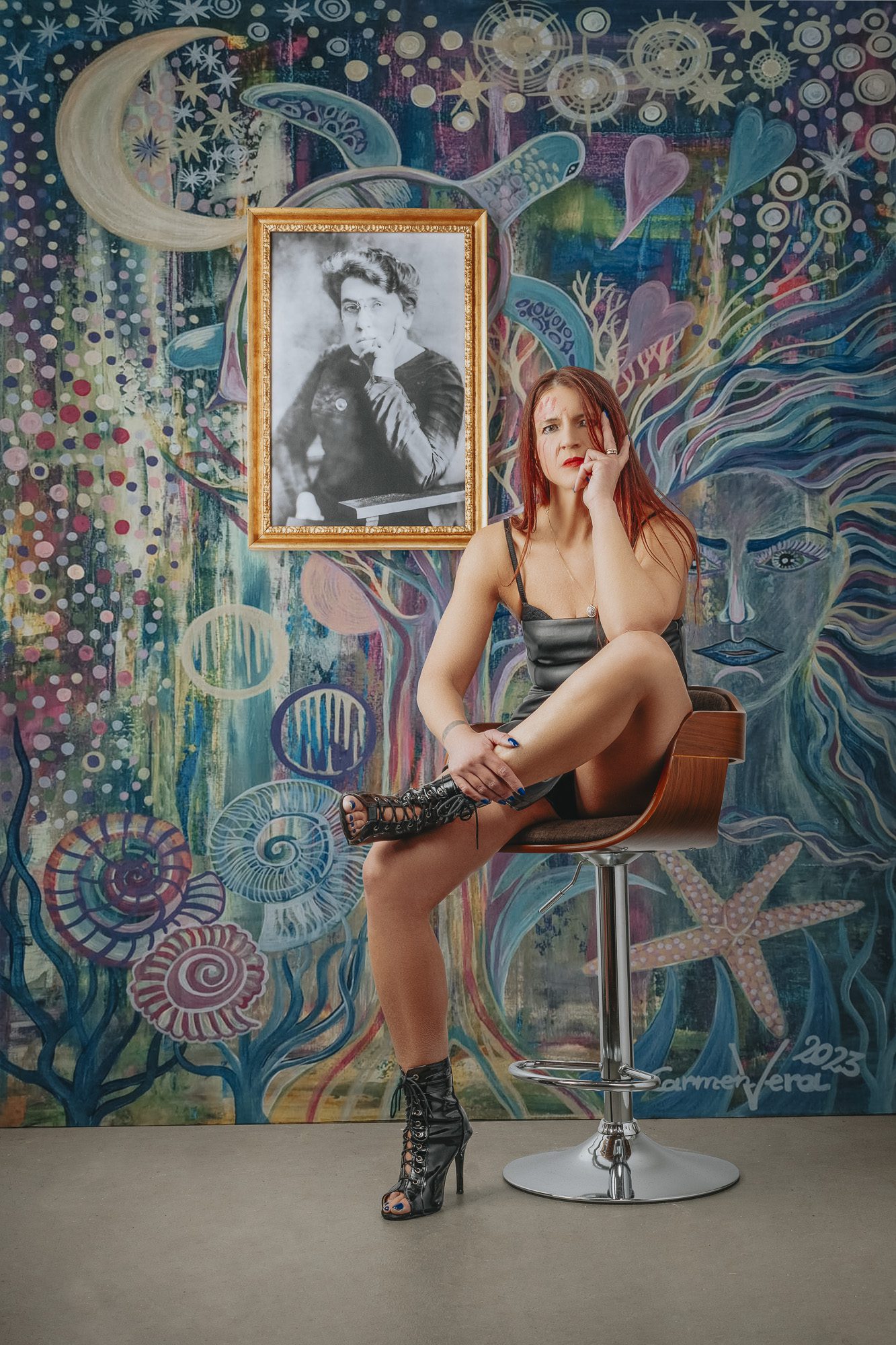
The semicolon comes before the word. Not after it, where you'd expect it to be. Before it.

“Freedom is non-negotiable,” CaRo wrote on a sheet of paper, then tore and singed the edges. When she held the sheet up in front of the camera, the image was set.
The punctuation mark is no coincidence. “Before the semicolon, there was a time when my freedom was still up for negotiation,” she says. The time before her inner transformation, before she found herself. After the semicolon comes the here and now—and the direction in which she is moving. The punctuation mark in between separates the two sections. “If it ended with a period and didn’t continue, I would have given up my freedom and never truly lived.”
Something comes to an end. Life goes on—new and different.
What Must Be Burned Down
CaRo Caparazzi is a painter. She painted the mural behind her herself in 2023: the moon, a turtle, stars, hearts, and a face with flowing hair. It’s not a subtle image. She sits in front of it, dressed in black leather, in front of her own work. Painter and model in one photograph.
Then came the break. In a short time, she left behind everything that had been holding her back: a marriage that wasn’t good for her, a religion that had shaped her since childhood, and a job that had made her sick. “I let everything in my life that was destroying me or painfully restricting me burn to the ground,” she says. She calls it her reset.
What followed was not immediate freedom. It was loneliness. “In this process, I encountered loneliness—and myself.” The victim became someone who takes responsibility. And the painter became an artist who also uses her own body as a medium.
For them, anarchy means exactly that: maximum personal responsibility for the individual. And the refusal to let systems—both public and private—destroy one’s own identity.
Why Emma Goldman
CaRo chose her companion herself. The choice is obvious.
Emma Goldman was born in 1869 in Kaunas, in what was then the Russian Empire. At sixteen, she came to America, worked in a textile factory in Rochester, and left an early marriage. The execution of the Haymarket anarchists in 1887 turned her into an activist. After that, she became a public speaker, published her own magazine,*Mother Earth*, and was a frequent subject of police reports. She was known as “Red Emma.”
In 1910, she wrote about what anarchism stands for: the liberation of the mind from the domination of religion, of the body from the domination of property, and liberation from the shackles of government.(My own translation, from “Anarchism: What It Really Stands For”)
You can compare this sentence to CaRo's life, point by point.
The Body.Goldman spoke publicly about sexuality, love outside of marriage, and contraception—and was arrested in 1916 for providing information about contraception. Today, CaRo says, “I am completely free of fear, shame, and guilt on an emotional level.” She created the art projectEros, which is not solely about sexual self-empowerment—although such symbolism plays a crucial role here—without conforming to conventional expectations. She also posed for a photo series as a symbol of freedom from gender roles, in which she symbolically dismantled censorship and personal limitations. She believes that art reaches people where politics cannot.
The War.In 1917, Goldman and Alexander Berkman founded the No-Conscription League to oppose the draft. For this, she was imprisoned for two years, and in 1919 she was deported from the United States. CaRo: “No mother in the world would willingly sacrifice her sons in war. Killing on command because others decide it is a traumatic violation of peaceful self-determination.”
Her voice.Goldman’s speeches were repeatedly broken up by the police; she was often arrested right off the podium. Yet she continued to speak. CaRo rediscovered her voice late in life: “I remained silent for far too long out of consideration for others, while ignoring my inner voice.” It wasn’t until it became unbearable to suppress it that she spoke up.
The Picture
Goldman hangs in a gold frame. A heavy, ornate frame—for a woman who refused to be confined by any boundaries. Her hand rests on her chin, her gaze pensive.
Among them is CaRo. Barefoot on a barstool, her legs crossed, only the tip of one toe touches the floor. She isn’t sitting still. She’s ready. Her gaze is fixed directly on the camera, without a smile, without seeking approval.
Two women, a good hundred years apart. The same refusal.
No mess
When people hear the word “anarchy,” they think of chaos. CaRo disagrees: “By no means do I mean chaos; rather, I mean the drive for maximum freedom coupled with mutual respect.” Everyone should be free to determine their own life—as long as they allow others the same freedom.
Goldman would have signed that. For her, anarchism was the philosophy of a new order based on freedom, not coercion. She also advocated for free schools where children learn to think for themselves rather than to obey. Today, CaRo hopes for the same thing, expressed in different words: that empathy, humanity, and self-determination be taught more than knowledge that serves the system rather than people.
Emma Goldman died in Toronto in 1940. She is buried in Chicago, near the Haymarket graves where it all began.
Her sentence isn't over yet. Neither is CaRos'.
"Portraits of Freedom" brings together people of today with historical figures who paid a price for freedom. If you'd like to contribute your own figure, please write to me.
The portrait is available as a print and as a limited edition — at stefanoviani.art.