Most of them accompanied me through my youth. I devoured their biographies and works in search of answers. Why is the world the way it is, and how can we make it a better place?
These thirteen people questioned the status quo and sought courageous answers beyond the established norms.
Their ideas and actions must be understood in the context of the times in which they lived and cannot be transferred unchanged to the present day. Nevertheless, their thoughts can still make an important contribution to shaping a just and dignified future, and many of their actions can serve as an example for future generations.
Especially today, at a time when the rich and powerful are taking control of history, it is all the more important to preserve the memory of these people and protect their ideas from being erased.

Pierre-Joseph Proudhon (1809–1865)
French social philosopher who coined the phrase "property is theft" in his work "What is Property?" (1840). Founded mutualism: federal self-government, exchange banks, interest-free credit. Influential for cooperatives and municipal federations.
https://de.wikipedia.org/wiki/Pierre-Joseph_Proudhon

Mikhail Bakunin (1814–1876)
Russian revolutionary and organizer, Marx's main opponent in the First International. Advocated collectivist anarchism and spontaneous uprisings against the state, the church, and authority. His writings influenced the anti-authoritarian wing of the labor movement.
https://de.wikipedia.org/wiki/Michail_Alexandrowitsch_Bakunin

Peter Kropotkin (1842–1921)
Russian geographer and natural scientist, leading figure of anarcho-communism. In "Mutual Aid," he argued for cooperation based on evolutionary theory. "The Conquest of Bread" outlines a decentralized communal economy beyond wage labor and the state.
https://de.wikipedia.org/wiki/Pjotr_Alexejewitsch_Kropotkin

Emma Goldman (1869–1940)
American activist of Lithuanian origin, icon for freedom of speech, anti-militarism, and sexual self-determination. Publisher/speaker, companion of Berkman; deported from the US in 1919. Her autobiography, Living My Life, remains a standard work.
https://de.wikipedia.org/wiki/Emma_Goldman
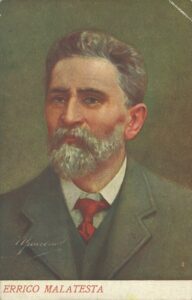
Errico Malatesta (1853–1932)
Italian anarchist, practical theorist of revolutionary organization. In exile for decades, he participated in strikes and uprisings; his essay "Anarchy" is considered a concise introduction to the subject. He emphasized "propaganda of the deed" in the sense of practical assistance and organization.
https://de.wikipedia.org/wiki/Errico_Malatesta

Louise Michel (1830–1905)
Teacher, feminist, and symbolic figure of the Paris Commune. After the defeat, she was deported to New Caledonia, where she campaigned for education, women's rights, and the poor. Her speeches and memoirs made her the "Red Virgin" of France.
https://de.wikipedia.org/wiki/Louise_Michel

Gustav Landauer (1870–1919)
German philosopher of libertarian socialism, emphasized community, culture, and voluntary associations. In "Call for Socialism," he propagated networks of free communities. Murdered in 1919 during the suppression of the Munich Soviet Republic by Freikorps.
https://de.wikipedia.org/wiki/Gustav_Landauer

Nestor Makhno (1888–1934)
Ukrainian peasant leader who organized the "Black Army" and libertarian communes (Makhnovshchina) during the civil war. Fought against the Whites, the Germans, and later the Bolsheviks. In exile in Paris; symbol of peasant self-government.
https://de.wikipedia.org/wiki/Nestor_Machno

Buenaventura Durruti (1896–1936)
Spanish anarcho-syndicalist (CNT-FAI), leader of the Durruti Column in 1936. Promoted collectivization in Catalonia/Aragón; died fighting for Madrid. Stood for militant defense and social revolution at the same time.
https://de.wikipedia.org/wiki/Buenaventura_Durruti

Lucy Parsons (c. 1851–1942)
American labor activist associated with the Haymarket trials (widow of Albert Parsons). Co-founder/ally of the IWW; fought for freedom of speech and assembly, against poverty and racism. An uncomfortable, uncompromising organizer.
https://de.wikipedia.org/wiki/Lucy_Parsons

Voltairine de Cleyre (1866–1912)
US writer and speaker, representative of "anarchism without adjectives." Combined feminism, anti-clericalism, and individual freedom. Her essays emphasize practical ethics, education, and tolerance between movements.
https://de.wikipedia.org/wiki/Voltairine_de_Cleyre

Alexander Berkman (1870–1936)
Russian-American activist; imprisoned for a long time after the attempted assassination of Frick (1892). Wrote Prison Memoirs of an Anarchist and the influential ABC of Anarchism. Deported in 1919; criticized authoritarian tendencies in the Soviet Union.
https://de.wikipedia.org/wiki/Alexander_Berkman

Noam Chomsky (1928)
World-renowned linguist and political intellectual, identifies as a libertarian socialist/anarcho-syndicalist. Critic of imperial politics and media power ("Manufacturing Consent"). Emphasizes grassroots democratic enterprises, councils, and federal self-government as goals.